
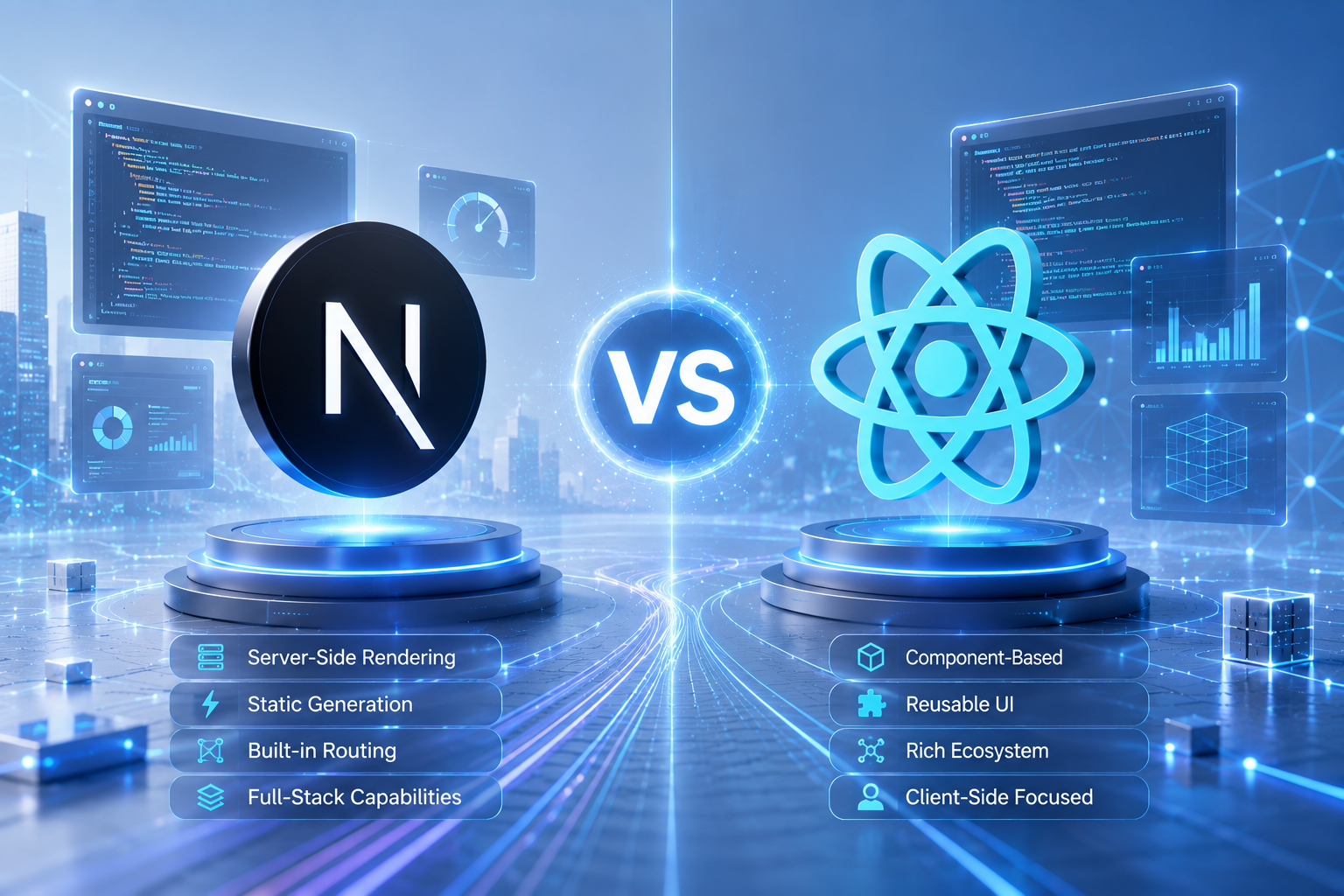
If you’ve spent any time researching modern web development, you’ve encountered the Next.js vs React debate. Both are central to how web applications are built today – but they serve different purposes, and choosing the right one from the start can save you significant time, cost, and rework down the line.
At Akshar Soft Solutions, Next.js is our primary framework. We’ve built everything from SaaS platforms and AI-powered tools to e-commerce frontends using both React and Next.js. Here’s our honest breakdown.
First – React Is Not a Framework
This is the most important thing to understand upfront. React is a JavaScript library for building user interfaces. It handles how your UI renders and updates – nothing more. Out of the box, React gives you no routing, no server-side rendering, no build optimisation, no image optimisation, and no SEO tooling.
Next.js is a full React framework built by Vercel. It takes React and wraps it in a complete production-ready structure – with built-in routing, server-side rendering (SSR), static site generation (SSG), API routes, image optimisation, and excellent SEO defaults. Every Next.js app is a React app. Not every React app is a Next.js app.
How They Differ – The Key Technical Distinctions
Rendering model
Plain React apps render entirely on the client side (CSR). The browser downloads a mostly-empty HTML file, then JavaScript runs and builds the page – slow for initial load and difficult for search engines to index reliably.
Next.js gives you multiple rendering strategies per page: SSR for dynamic content, SSG for pre-built content, and ISR which rebuilds specific pages in the background. The App Router (stable in v14/v15) also supports React Server Components – allowing components to fetch data directly on the server with zero client-side JavaScript.
Verdict: Next.js wins for rendering flexibility. React CSR is only appropriate for apps where SEO doesn’t matter at all.
SEO
A pure React SPA is fundamentally harder to index. JavaScript-rendered content is still indexed less reliably and more slowly than server-rendered HTML. Next.js generates real HTML on the server for every page – which search engines can index immediately. Meta tags, Open Graph, canonical URLs, and sitemaps are all straightforward with the built-in Metadata API.
Verdict: Next.js wins clearly for any project where organic search traffic matters.
Performance
React CSR requires the browser to download, parse, and execute all JavaScript before anything renders. Next.js SSR and SSG serve pre-rendered HTML immediately. Combined with automatic code splitting, the built-in Image component, and font optimisation, Next.js apps consistently achieve better Core Web Vitals scores.
Verdict: Next.js wins on performance for real-world users.
Development complexity
React has a lower initial learning curve but as your app grows, you’ll assemble your own routing, data fetching, auth, and build setup. Next.js has more to learn upfront but provides a clear, opinionated structure that scales well and reduces architecture decisions for your team.
Verdict: React is simpler for small projects; Next.js scales better for production applications.
Full-stack capability
React is purely a frontend library. Next.js includes Route Handlers that let you write backend API endpoints within the same codebase. Combined with Prisma, Supabase, or any Node.js-compatible database client, Next.js can power a complete full-stack application from a single repository.
Verdict: Next.js wins – it can replace a separate Node.js/Express backend for many use cases.
When to Use React (Without Next.js)
- Internal tools and dashboards where SEO is irrelevant
- Applications deployed behind authentication (login required to view anything)
- React Native mobile apps
- Projects needing full control over rendering architecture
- When integrating into an existing non-Next.js infrastructure
When to Use Next.js
- Any public-facing website or web app where SEO matters
- SaaS platforms, marketplaces, and product landing pages
- E-commerce frontends and headless commerce builds
- Content-driven sites, blogs, and marketing pages
- AI-powered web applications (Next.js + OpenAI or Claude API is a natural combination)
- Full-stack applications where you want frontend and API in one codebase
What We Recommend at Akshar Soft Solutions
For any new project we start today, Next.js with TypeScript is our default — unless there’s a specific reason to use plain React. The combination of server-side rendering, excellent SEO defaults, built-in performance optimisation, and full-stack API capability makes Next.js the right choice for the vast majority of modern web applications.
We’ve built AI-powered platforms, SaaS products, consulting simulators, and e-commerce frontends with Next.js — and consistently found it to be the framework that best balances developer experience with production performance.
If you’re starting a new project and want expert advice on the right stack, we’re happy to help before you commit to an architecture.