
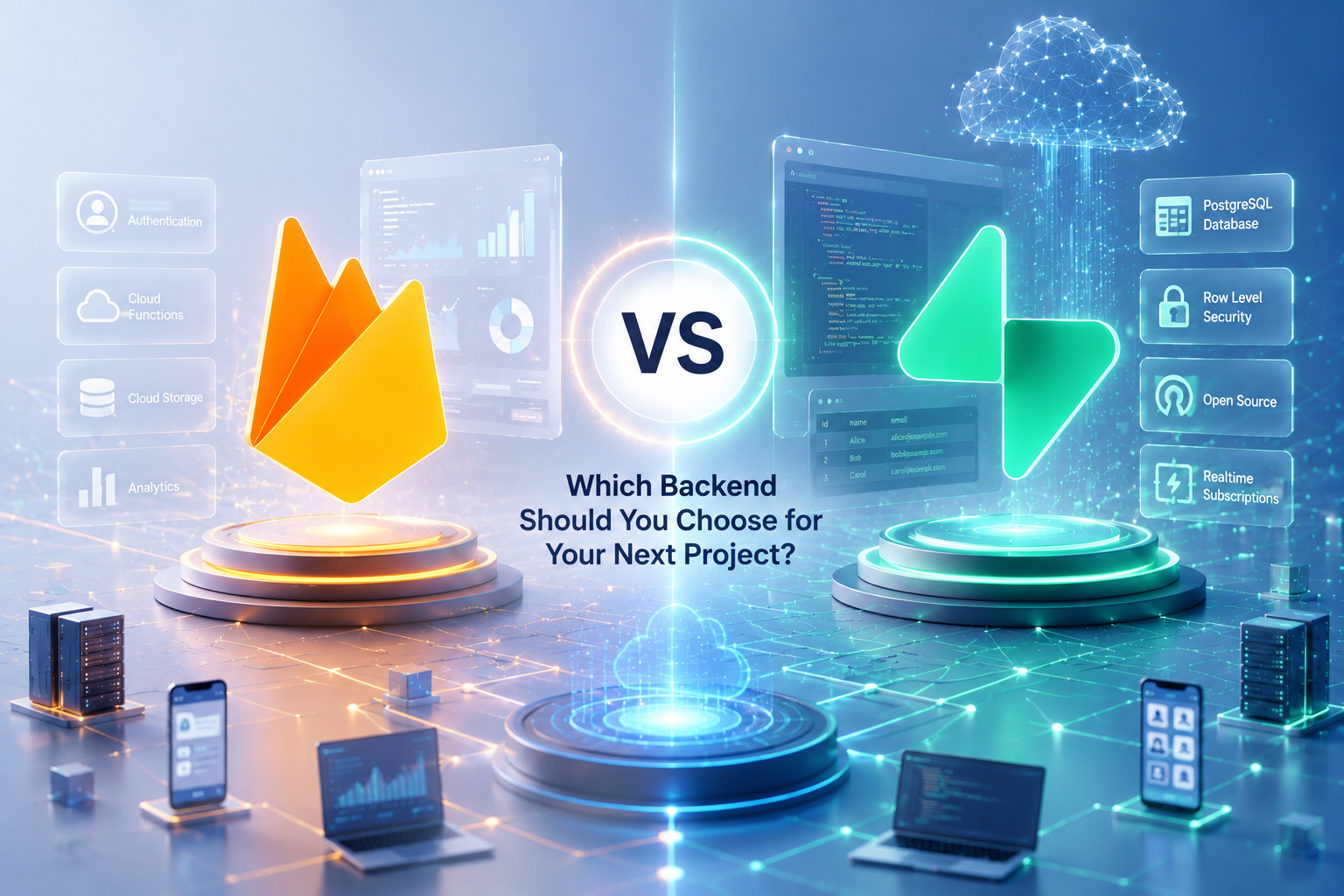
If you’re building a web app or mobile app in 2026 and evaluating your backend options, you’ve almost certainly landed on the Firebase vs Supabase comparison. Both are powerful Backend-as-a-Service (SaaS) platforms that handle authentication, databases, storage, and real-time functionality – but they make very different architectural choices, and picking the wrong one can create significant pain down the road.
At Akshar Soft Solutions, we’ve worked with both platforms across multiple client projects. Here’s our honest, developer-level comparison to help you choose.
What Is Firebase?
Firebase is Google’s BaaS platform, built around a NoSQL document database (Firestore) and a real-time database. It’s particularly strong for mobile apps, real-time features, and rapid prototyping.
Core Firebase offerings: Firestore (NoSQL), Firebase Authentication, Cloud Functions, Firebase Hosting, Cloud Storage, Firebase Analytics.
What Is Supabase?
Supabase is an open-source Firebase alternative built on PostgreSQL. It gives you a real Postgres database with all the power of SQL, joins, foreign keys, and stored procedures — plus auth, storage, and edge functions.
Core Supabase offerings: PostgreSQL database, Auth with Row Level Security, Edge Functions, Storage, Realtime subscriptions, REST and GraphQL APIs auto-generated from your schema.
Firebase vs Supabase – Head to Head
Database model
Firebase uses Firestore, a NoSQL document database. Flexible for unstructured data, but complex for relational queries. Supabase uses PostgreSQL — the world’s most advanced open-source relational database. Joins, foreign keys, complex queries, full-text search — all standard.
Verdict: If your data is relational, Supabase wins clearly. For simple document-style data with heavy real-time needs, Firebase holds its own.
Pricing
Firebase pricing is consumption-based and can become unpredictable at scale. Supabase pricing is more predictable — a flat monthly fee per project tier, with a generous free tier. For startups and SMEs, the cost trajectory is easier to plan around.
Verdict: Supabase is more budget-friendly and predictable for most projects.
Open source and vendor lock-in
Firebase is fully proprietary — migrating away is a significant engineering effort. Supabase is open-source and self-hostable. Your data lives in standard PostgreSQL, exportable and portable.
Verdict: Supabase wins on flexibility and avoiding vendor lock-in.
Real-time capabilities
Firebase’s real-time database was built for real-time from day one — excellent for live chat, live collaboration, and push notifications. Supabase’s real-time subscriptions work well but aren’t as battle-tested.
Verdict: Firebase wins for heavily real-time applications.
Authentication
Both offer solid auth with email/password, social logins, and magic links. Supabase adds Row Level Security (RLS) directly in the database — a powerful pattern for access control.
Verdict: Roughly equal, but Supabase’s RLS gives it an edge for security-sensitive applications.
Mobile development
Firebase has first-class SDKs for iOS, Android, Flutter, and React Native with deep Google ecosystem integration. Supabase has good mobile SDKs but fewer native mobile integrations.
Verdict: Firebase wins for mobile-first applications.
When to Choose Firebase
- Your app is mobile-first (Android, Flutter, iOS)
- You need battle-tested real-time functionality (live chat, multiplayer)
- You’re prototyping fast and want minimal setup
- Your data model is document-based, not relational
- You’re already deep in the Google Cloud ecosystem
When to Choose Supabase
- Your data is relational and you’re comfortable with SQL
- You’re building a SaaS platform, admin dashboard, or data-heavy web app
- Predictable pricing matters (startup, bootstrapped project)
- You want open-source and to avoid vendor lock-in
- You’re building with Next.js — Supabase + Next.js is a very natural pairing
Our Recommendation
For most web applications we build at Akshar Soft Solutions — particularly Next.js SaaS platforms and data-driven web apps — Supabase is our default choice. The combination of PostgreSQL, Row Level Security, auto-generated APIs, and clean Next.js integration makes it exceptionally productive.
Firebase remains our recommendation for mobile-first apps and projects where real-time is the core feature. The honest answer is: the best backend is the one that matches your data model and your team’s strengths.
If you’re unsure which fits your project, we’re happy to advise before you start building.